

A reading list about being/staying human
Part 2 of our summer reading list: 17 books on ambition, grief, meaning, and what people do when things get complicated.

Here are a few more books the a16z crypto team is reading and recommending this summer.
The first part of our list focused on how things work: technologies, markets, institutions, organizations, energy, biology, and the systems behind change.
This second part turns to people: how they adapt, grieve, improvise, and generally carry on. In this list, you’ll find fiction, memoir, history, philosophy, and science fiction — books about what people do when things get complicated.
How people keep going
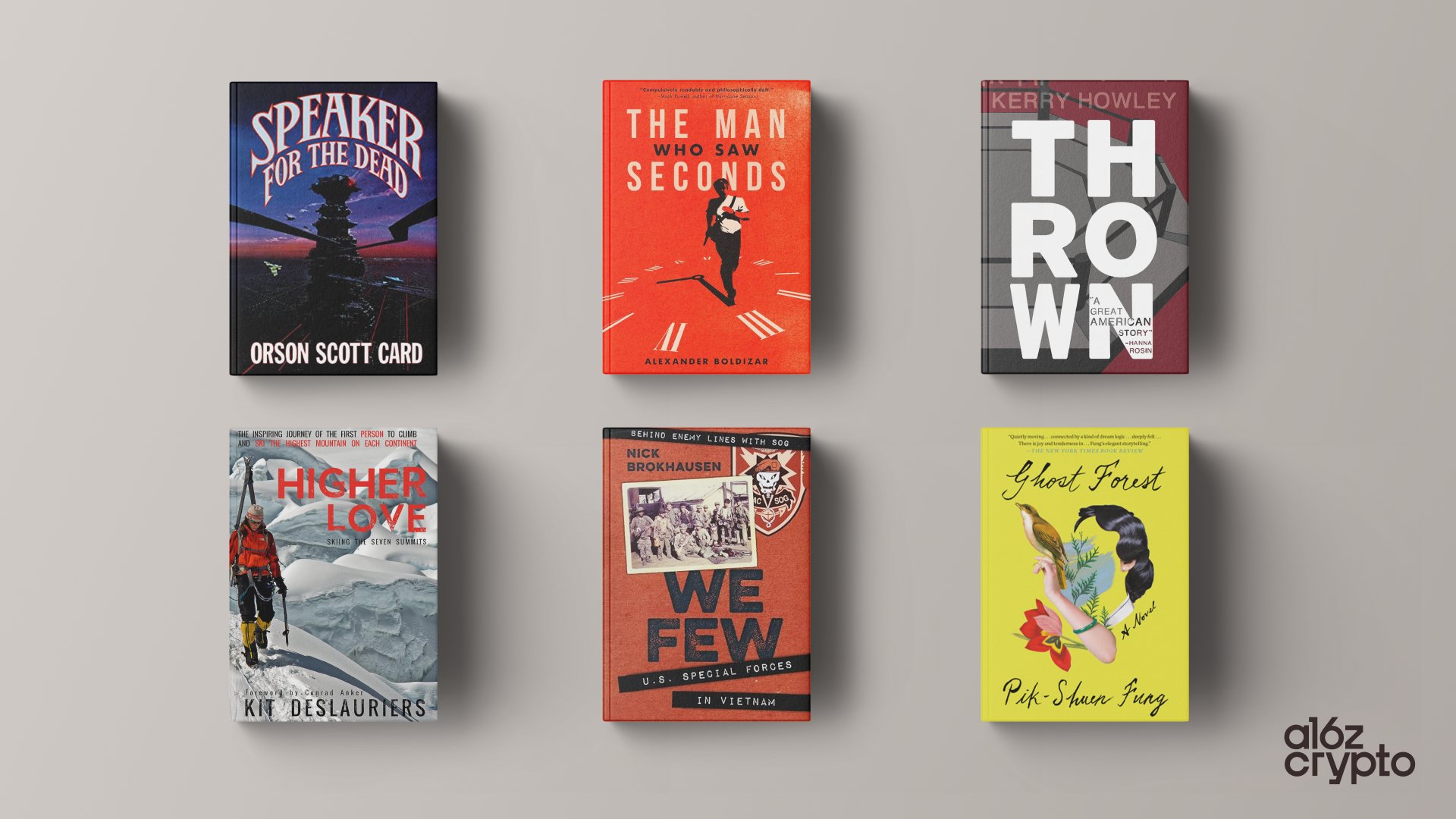
We Few: U.S. Special Forces in Vietnam by Nick Brokhausen
“Brokhausen’s memoir of MACV-SOG, the unit that ran the most dangerous missions of the Vietnam War behind enemy lines in Laos and Cambodia, is the rawest portrait of high-performing operators I’ve read. What stays with you is the psychology of doing something unprecedented and lethal, the macabre humor, and the resilience it takes to keep walking into the jungle, knowing each step might be the last. For anyone who works in adversarial, high-stakes environments, it’s a bracing look at what real edge cases demand.” – Conner Lyons Brown, tech ops
Higher Love: Climbing and Skiing the Seven Summits by Kit DesLauriers
“Inspiring first-hand account of a fearless skier and mountaineer conquering a massive feat — climbing and skiing the world’s seven highest peaks. It gives a peek into what drives her to complete this impressive feat but also the very real fears and circumstances she has to overcome. The book also introduces you to a colorful cast of characters that make up the climbing community around the world, who band together to help Kit reach her dream.” – Kim Milosevich, marketing
The Cold Cold Ground by Adrian McKinty
“What do you do if you’re a Catholic copper in Protestant Belfast at the height of The Troubles? You check under your car for a bomb every morning before going to work. Adrian McKinty’s The Cold Cold Ground combines the kind of detective story I like with a vividly realized setting. Belfast in 1981 is a place where every institution is contested, and every identity carries consequences. Sean Duffy solves crimes while navigating that landscape with intelligence, wit, and a healthy appreciation for the possibility that someone may be trying to kill him. The result is both gripping and funny — just the kind of police procedural I love.” – Tim Sullivan, editorial
How people improvise
The Man Who Saw Seconds by Alexander Boldizar
“A fascinating speculative-fiction framework: what happens if one can see just a tiny bit into the future, and pick the preferred passage through time? While you might hope that you could just spend those precious seconds winning at casinos, such a metaphysical gift — at least seen through a certain lens — might put pressure on the very foundations of civil society.” – Scott Duke Kominers, research
The Warrior’s Apprentice by Lois McMaster Bujold
“Lois McMaster Bujold’s The Warrior’s Apprentice follows Miles Vorkosigan, a brilliant, physically fragile young noble who fails his military entrance exam and then, through bluff, charisma, and improvisation, accidentally assembles a mercenary fleet. It is a great space opera, full of tactics, politics, and action, but what makes it memorable is how much it leans into character development, relationships, and comedy. Miles’s superpower is not technology or force; it’s his understanding people well enough to turn chaos into coordination.” – Jason Rosenthal, operations
The Will of the Many by James Islington
“I loved how The Will of the Many blends an elite academy setting, Roman-inspired politics, and a genuinely propulsive mystery. The book is smart and immersive without feeling slow and it has novel world-building.” – Liz Harkavy, deal
How people carry grief
Think You’ll Be Happy: Moving Through Grief with Grit, Grace, and Gratitude by Nicole Avant
“A book about grief, purpose, and the legacy a mother leaves behind — woven with stories from music, culture, and politics.” – Hoang Nguyen, marketing
Speaker for the Dead by Orson Scott Card
“When I was younger, I tried reading Speaker for the Dead many times. It was tucked into the back half of my well-worn copy of Ender’s Game, which I had devoured. I could never get past the first chapter.
Speaker was unlike everything I loved about the Ender saga. No pressure cooker for child prodigies. No eerie, video game-mediated, psychoanalytic dream sequences. No fate of humanity hanging in the balance. And where the Formics were terrifyingly badass, these aliens were… ‘piggies’? C’mon.
I’ve always felt a kinship with Ender, as I suspect most kids who become engrossed in the story do. By some cosmic coincidence, I was surprised to discover that I’m the same age as he is in Speaker, just as I was his age when I first read Ender’s Game decades ago. Then as now, it has always fascinated me that Card considered Speaker to be the book he had really set out to write, and that he rushed the first book merely to tee it up. How could that possibly be the case?
I think I understand better now. Speaker lacks the narrative perfection — and kinetic energy — of its prequel, but I can appreciate its slower, contemplative pace far more now that I’m older. It deals with themes like family, memory, death, otherness, forgiveness, guilt, and redemption — subjects I cared, apparently, less about in my youth. I still find Speaker challenging to love, but I respect the way it complicates the story I loved so much growing up. I still prefer Ender’s Game, but I have a much better sense of why Card saw Speaker as his true purpose.” – Robert Hackett, editorial
Ghost Forest by Pik-Shuen Fung
“A slim, soft, and plainspoken piece of autofiction on loss, grief, and the complexity of parent/child relationships. The narrator grows up in Canada with an ‘astronaut father’ who lives in Hong Kong for work — so the relationship she’s mourning was mostly conducted across an ocean, in short visits and longer silences.
As a bonus, the book includes some lovely depictions of death rituals and mourning practices, particularly in the sections on Hong Kong and the family’s Chinese cultural background. It’s short enough to finish in one sitting, but it stuck with me long after.” – steph zinn, editorial
How people become institutions
Fahrenheit-182: A Memoir by Mark Hoppus and Dan Ozzi
“Punk rejects mass culture. Pop is mass culture. So how does a pop-punk band like Blink happen?
In his memoir, bassist and the only constant member, Mark Hoppus, recounts playing a show in Bologna where the crowd hurled rocks and bottles at them. A year earlier, Blink had released a viral video mocking boy bands, and had become so successful that some audiences — a contingent of hostile Italian metalheads, in this case — could not tell the parody from the thing being parodied. Or didn’t care to. As Hoppus puts it: ‘They didn’t want some bullshit American pop act fucking up their heavy show.’
I love this anecdote — not just because it’s darkly comic, guitarist Tom DeLonge reportedly swore off pasta bolognese afterward, and boy bands are dumb, but because it illuminates one of modernity’s supreme ironies: What happens when countercultures go mainstream. A similar arc can be traced across jazz, abstract art, hip-hop, skateboarding, streetwear, open source software, and, relevantly for this audience, crypto.
Fahrenheit-182 is also a founder story. Hoppus and DeLonge are a volatile creative duo — like Lennon and McCartney with fart jokes. The same forces that allowed them to pump out hits eventually tore them apart. Fortunately, unlike most founder breakups, this one had a reunion tour. I caught them at Madison Square Garden a few years ago, and it was a glorious, stupid, perfect blast of nostalgia.
So is the book.” – Robert Hackett, editorial
Catherine the Great & Potemkin: The Imperial Love Affair by Simon Sebag Montefiore
Just your standard romance, but with more urban planning and foreign-policy memos. Catherine the Great & Potemkin is part imperial history, part power-couple biography, and part extremely high-stakes situationship. The story of this Antony-and-Cleopatra-level romantic and political partnership is told with all the drama and detail you’d hope. – steph zinn, editorial
Augustus by John Williams
“Everyone always talks about Stoner, but not enough people talk about John Williams’s other incredible work: Augustus. Told in epistolary form, this portrait of Augustus as an idealist and pragmatist feels deeply relevant.” – Drew Coffman, editorial
How people search for meaning
The Education of Henry Adams by Henry Adams
An extraordinary reflection of living through a period of intense technological change. Adams reflects on how the educational system failed to anticipate the radical transformation he experienced, and describes where he learned life’s true lessons. A classic and timeless book that’s perfect for today’s moment. – Andy Hall, research
I See Satan Fall Like Lightning by René Girard
“One of the most thought-provoking frameworks that reveals why we desire the things we desire and what this implies for how society is organized. If you love philosophy, anthropology, history and theology — great read.” – Robbie Petersen, deal
Thrown by Kerry Howley
“In this work of literary nonfiction, maybe, the narrator, Kerry Howley — who may be the same person as the author, but may not be — follows a pair of mixed martial artists around Iowa, where author Howley had done her MFA. Both Howleys explore obsession, uncertainty, and the search for meaning with unusual intelligence and empathy — and with a prose style that both surprises and delights. It’s nominally a book about fighting, but it’s really a book about commitment, and maybe a book about a book about fighting.” – Tim Sullivan, editorial
Sátántangó by László Krasznahorkai
“This is one of the unique books I liked mainly for its narrative style, characterized by lengthy sentences and complex paragraphs. Very Kafkaesque undertones as well.” – Ertem Nusret Tas, research
Leisure: The Basis of Culture by Josef Pieper
“Pieper wrote this in 1948, but it reads as if it were written for the age of AI. He diagnoses the two roads most traveled by any professional: the total world of work, where a person’s worth collapses into output, and a hollow pursuit of pleasure with no center. Pieper refuses both. Leisure, he argues, is not idleness or time off but a contemplative, receptive stance toward reality, the stillness to actually perceive the world rather than just operate on it. As AI absorbs more of the doing, the open question becomes what the doing was ever for, and Pieper’s answer, that the highest human activities are the ones done for their own sake rather than for compensation, lands harder now than when he wrote it.” – Conner Lyons Brown, tech ops
You’re receiving this newsletter because you signed up for it on our websites, at an event, or elsewhere (you can opt out anytime using the ‘unsubscribe’ link below). This newsletter is provided for informational purposes only, and should NOT be relied upon as legal, business, investment, or tax advice. This newsletter may link to other websites or other information obtained from third-party sources — a16z has not independently verified nor makes any representations about the current or enduring accuracy of such information. Furthermore, the content is not directed at nor intended for use by any investors or prospective investors in any a16z funds. Please see a16z.com/disclosures for additional important details, including link to list of investments.