

Everyone's wrong about quantum computing
Timelines to cryptographically relevant quantum computing and how that affects blockchains. Plus, Fidelity's Abigail Johnson on Bitcoin, stablecoins, and TradFi’s tipping point.

INNOVATION BETS
TradFi’s tipping point: Fidelity CEO Abigail Johnson on stablecoins, Bitcoin, and more
Fidelity Chairman and CEO Abigail Johnson takes us inside the institution’s decade-long journey in crypto — from early Bitcoin mining to building custody infrastructure that other institutions now rely on, to thoughts on stablecoins then vs. now and on how the company decides what to build vs. buy.
Johnson reveals (in conversation with a16z crypto COO Anthony Albanese) how Fidelity sifted through dozens of use cases, why only one truly mattered at first, and how that early insight set the course for everything that followed.
Whether you’re a traditional finance institution exploring crypto, a startup seeking to partner with TradFi, or just someone who wants to understand how innovation happens inside large, established institutions — this episode is your guide to what we’ve been calling “The Year of Institutional Adoption” and beyond.
00:47 – “Is this real?”: Early experiments
02:30 – A use case that changed everything
04:18 – Surprises in early bitcoin mining
05:44 – First consumer business
08:50 — Embedding throughout Fidelity
10:00 – Responding to the regulatory freeze
13:19 – Stablecoin then and now
16:59 – Build vs. buy
20:20 – How to operationalize the new
24:12 – Replace vs. rebuild financial system?
28:26 – Thoughts on bitcoin
30:17 – Handling skepticism, “religious wars”
32:30 – Innovation vs. inertia, taking risks
34:07 – The future of crypto x TradFi
THE ARGUMENT
Quantum computing and blockchains: Let’s match the urgency to the actual threats
Justin Thaler
Timelines to a cryptographically relevant quantum computer are frequently overstated in press releases, media, and elsewhere — leading to calls for urgent, wholesale transitions to post-quantum cryptography.
But these calls often ignore the costs and risks of premature migration, and also overlook more salient security issues (like bugs).
So in this piece, Thaler clarifies common misconceptions about quantum threats to cryptography — covering encryption, signatures, and zero-knowledge proofs — with a special focus on implications for blockchains. He begins by addressing the question of: Where are we, really, on timing — especially given several high-profile claims out there?
read the post (plus 7 recommendations for builders, policymakers, others)
NEWS AND MOVES
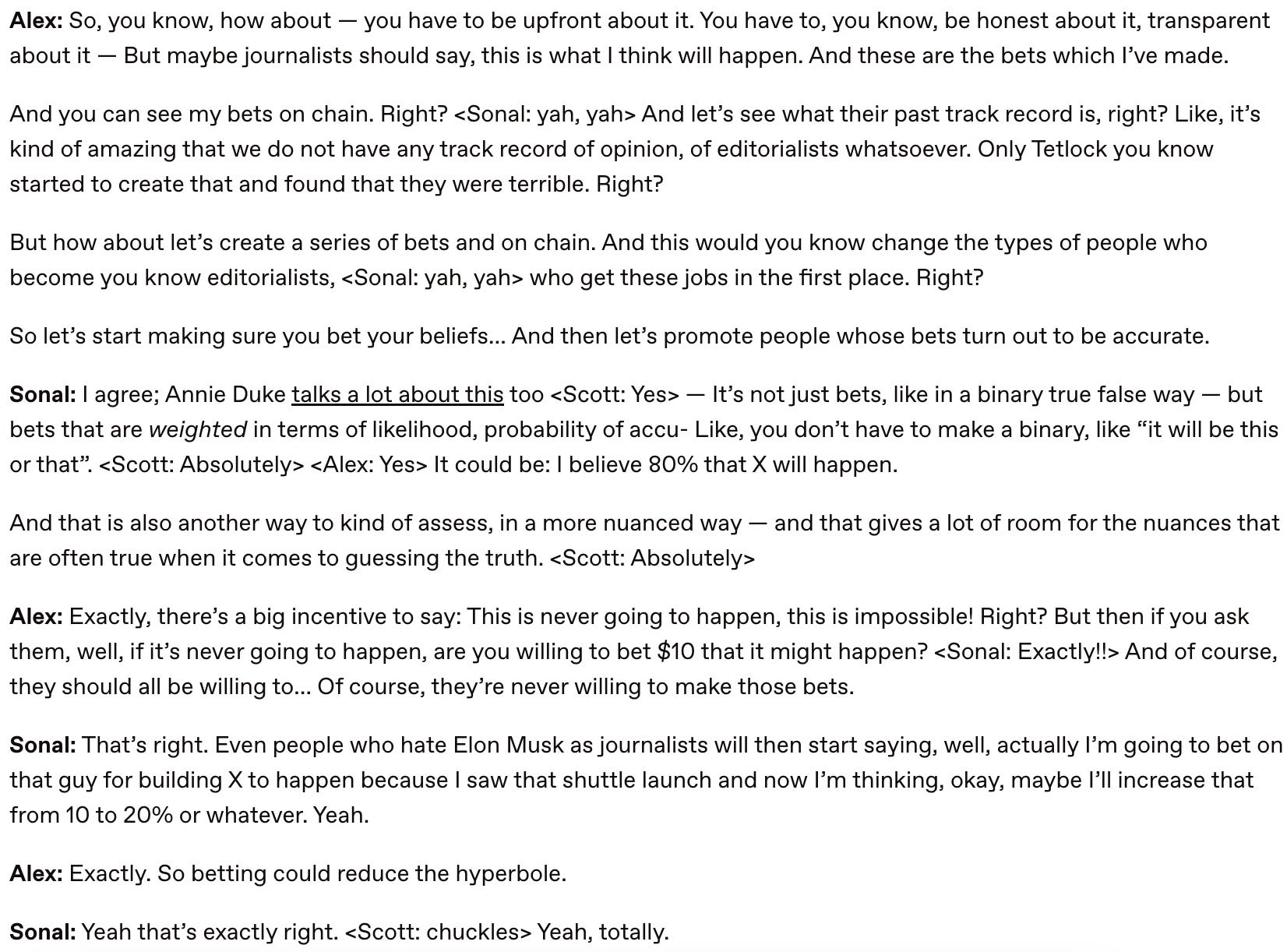
This week, prediction market Kalshi announced data partnerships with two different media outlets: CNN and CNBC — with the goal of helping share “unfiltered, accurate, and market-driven” data on content such as news, politics, culture, and weather.
For more on how media can embrace prediction markets and what’s possible, see our previous explainer on prediction markets including many broader use cases; part of the discussion on media specifically excerpted below:

TALKING TRENDS
On AI, crypto, and how network effects power everything
Why do some consumer products explode into networks that reshape the internet, while others fade away? General partners Chris Dixon and Anish Acharya explain how composability, network effects, and the new economics of AI are changing the game for consumer startups.
The two discuss what it takes to build enduring consumer apps, how tools evolve into networks — and why niche communities like early crypto and open source movements can trigger massive technological shifts.
0:33 Power of networks & network effects
2:08 Composability, open source growth
5:35 Rise of consumer tools & networks
6:50 Advice for founders
10:08 Brand, pricing, defensibility
14:58 Movements, niche communities, more
19:57 The impact of timing
21:02 Second-order implications?
24:06 “Narrow startups” & platform shifts
30:55 Native vs. skeuomorphic tech
34:20 New art media & prompt engineering
36:54 Open source AI, future of tech
— a16z crypto editorial team
You’re receiving this newsletter because you signed up for it on our websites, at an event, or elsewhere (you can opt out any time using the ‘unsubscribe’ link below). This newsletter is provided for informational purposes only, and should NOT be relied upon as legal, business, investment, or tax advice. This newsletter may link to other websites or other information obtained from third-party sources — a16z has not independently verified nor makes any representations about the current or enduring accuracy of such information. Furthermore, the content is not directed at nor intended for use by any investors or prospective investors in any a16z funds. Please see a16z.com/disclosures for additional important details, including link to list of investments.