

Kill the press release
Exorcising a ghost of corporate comms past

By the way, you can now catch our coverage on news you can use — hot topics, fact checks, trends, industry moves — here; we'll continue to let you know the latest every week in this newsletter.

Press releases are the Rasputin of tech communications: They simply won’t die. Press releases were essential once, but haven’t been useful for a long time.
When I started my career as a public relations intern in the early 2000s, one of the first things I learned was how to write a press release. Any self-respecting company making an announcement was following this well-established process:
Write a press release in the third person, as if an outsider visited your office to get the scoop and is filing it to their editor.
Pay a newswire, like PR Newswire or Business Wire, to publish your news on their website and make it visible to newsrooms.
Every announcement followed a standard press release format, not least because the newswires required it:
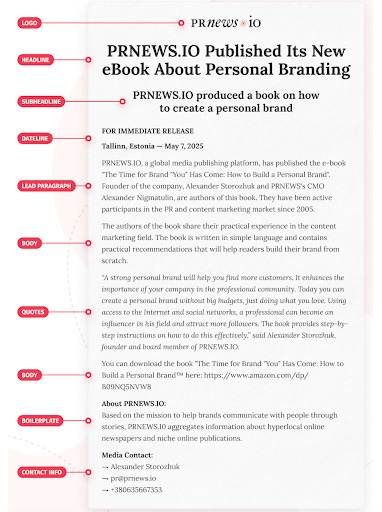
Distributing press releases over newswires was a colossal waste of time and money, even then. It wasn’t effective for companies or helpful for journalists. Thousands of releases crossed the wire each day, often within just a few hours of the early morning. Reaching an interested journalist with your announcement was akin to shouting at them from a roaring stadium crowd. So if you wanted specific journalists to actually see your announcement, you still had to email or call them directly.
I’m recounting this to you not for nostalgia’s sake — although it’s kinda funny that I used to spend hours faxing press releases to newsrooms. My point is this: over the course of my career, the media environment has changed in nearly every respect, and then changed again. We were introduced to blogs, Twitter, podcasts, and TikTok, and now companies have endless options for distributing their announcements.
And yet! That traditional, staid press release format hasn’t gone away. Many companies — even extremely online crypto startups — still believe their announcements should be optimized for 20th-century journalists and delivered through a newswire.
Can we all move past this, please? It’s time to kill the press release.
Now, don’t get me wrong. I’m not saying companies should stop writing long-form announcements and distributing them to journalists. That’s still an important part of shaping the narrative. But unless you’re a public company following SEC mandates to release your quarterly earnings, you should not be writing in that old-timey press release format or distributing it over a paid newswire.
Write a blog post instead. It does everything press releases can do, and more.
Blog posts are better because:
They can be written for the audiences that really matter to you, not just for journalists, and in any format you want. Journalists used to be the conduit through which anyone could hear about your announcement, so it made sense to write specifically for them. Your customers and partners are now reading your announcements directly, or at least they should be. So write for them instead, in format and tone. That means first-person framing (i.e., “we are…” not “TechCorp is…”), a more friendly, conversational tone than a formal one, and embedded images and videos.
They can live on your own website, Substack, or X feed, wrapped in your branding and an easy click away from the rest of your offerings. Newswires will try selling you on their SEO benefits, but why would you want people visiting spammy syndication sites to read your announcement?
They’re easy to update after publishing, whenever you need to correct a mistake, add a new link or image, add an update to an older announcement, etc. By contrast, you lose control of a press release as soon as it crosses the wire and syndicates to all those random sites.
The medium is the message, and the press release’s message is that your company is corporate and old-fashioned. Is that what you’re going for?
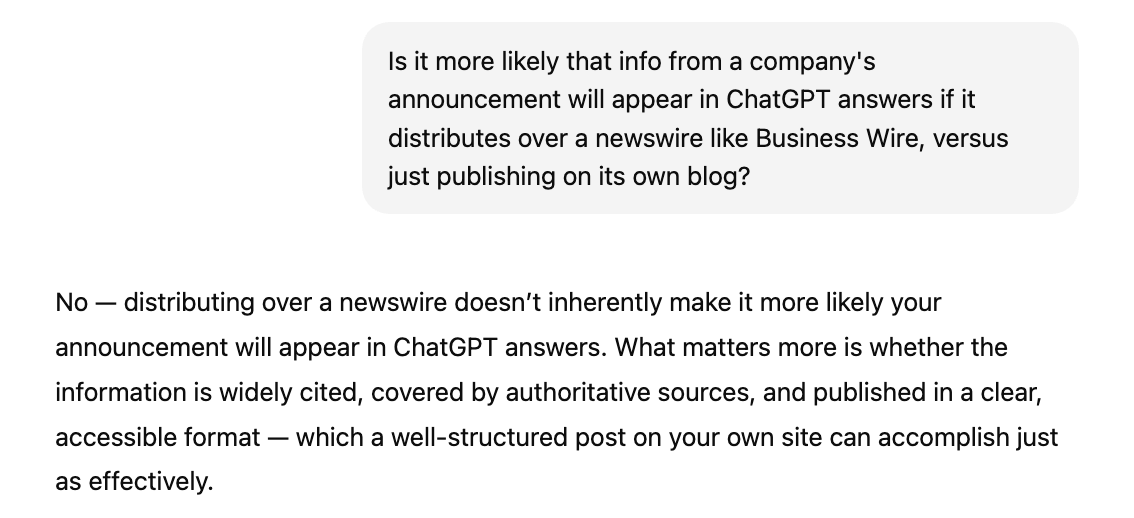
“Hold on now,” you’re probably saying. “You’ve just dated yourself by only mentioning SEO. Don’t you know that GEO is what matters to marketers now? Distributing my announcement on a newswire has to be more effective for that, right?”
Let’s ask ChatGPT:
OK, what about the journalists? Should you still write a press release for them and reach everyone else with a blog post? Absolutely not:
Blog posts have been a standard announcement format for tech companies for well over a decade, and journalists long ago adapted to writing articles based on them. When you send the full post to a journalist, make it easy for them by calling out the most important and newsworthy aspects upfront.
You’ve already got a long to-do list to make the announcement a success. Why spend time writing two different announcements that say basically the same thing, for no clear benefit?
Let’s make every company’s announcement more readable, visible, and profitable in 2026. Let’s kill the press release.
You’re receiving this newsletter because you signed up for it on our websites, at an event, or elsewhere (you can opt out anytime using the ‘unsubscribe’ link below). This newsletter is provided for informational purposes only, and should NOT be relied upon as legal, business, investment, or tax advice. This newsletter may link to other websites or other information obtained from third-party sources — a16z has not independently verified nor makes any representations about the current or enduring accuracy of such information. Furthermore, the content is not directed at nor intended for use by any investors or prospective investors in any a16z funds. Please see a16z.com/disclosures for additional important details, including link to list of investments.
Yes! I mean, press releases are great. You need it for internal comm, patents, an even clients. But distribute to your own domain. Done.